SAFETY FIRST: Outdoor Education is as safe as necessary. Please read the Canadian Paediatric Society's post here: Position Statement on Outdoor Risky Play

Lessons through an Indigenous Lens

Heartbeat of the Earth by Laura Purcell has taught me a lesson opening and games for my students. The games encourage physical and social health while teaching about Indigenous ways.
Thank you for this beautiful day
Thank you for this life
Thank you for the water which life would not be possible.
Thank you for Grandmother Earth who protects and nourishes us
Lakota people
This is the opening I use for lessons. I say one line at a time and the students repeat that line. It sets the tone that we are in nature's home and we need to respect it. It also is a calming way to start the lesson. By the end of the school year the students knew it by heart and wanted to be the leader for the opening.
The opening comes from the Lakota people. Although those people are not near where I teach I believe it is important to teach students about many communities. Exposure to other cultures is key to gaining knowledge and acceptance of all.
Heartbeat of the Earth has other openings I can use in other years. If you have an opening you use in your outdoor lessons please send an email. With your permission I can include it here.
Please see below games from this educational book. I recommend adding it to your library.
Please click the tree for the PE tab for more game ideas.


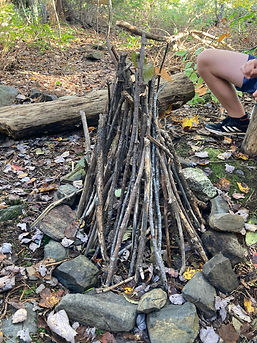
When I told my students we were playing Fire Keeper they worked together to make a fire! I didn't ask them to do this, but they were working together so I did not stop their efforts. After the game for safety reasons I did scatter the sticks.

My students enjoy this game because they get to scream! We stop half way to our forest area and play it. This puts us at our forest area.

Back to Indigenous
Back to Physical Education
If you make a purchase through the Outdoor Learning Store, a charitable social enterprise, 100% of proceeds will go back to outdoor learning non-profit initiatives.
READ ALOUD
There are many books that have been written using an Indigenous Lens. Please see the Resources tab for more resources. I divided the books for a Read Aloud into two sections; one in Language Arts: Read Aloud and one here in Lessons with an Indigenous Lens so as not to overwhelm either section. There are so many educational (and fun!) books you can read out loud while sitting outside with your students.
The Land Know Me A Nature Walk Exploring Indigenous Wisdom by Leigh Joseph
Purchase through the Outdoor Learning Store or other places
I tell my students there many plants, roots, and herbs in nature that can be eaten or used for medicine, however I and you do not have that knowledge so it is not safe for us to eat or use anything from nature. However this book gives a glimpse into those that do. I also add a career connection by saying when you are grown up you might become a botanist and therefore be able to be safe with items in nature. My students and I find it an interesting read.
The write up states:
Through the Indigenous traditions of Squamish culture you’ll learn how to ground yourself on the land, how to introduce yourself in the Squamish language to your plant relatives, and the many teachings about plants, cultural stories, and learnings related to the flora seen on your walk.
This essential and colorful introduction to Indigenous plant knowledge includes informative sidebars, reflection questions, and plant names in both Squamish and English so children can learn a new language.
For older students please view Leigh Joseph's book: Held by the Land: A Guide to Indigenous Plants for Wellness
Sila and the Land by three Indigenous authors Ariana Roundpoint, Shelby Angalik, and Lindsay DuPré Illustrated by Indigenous artists Halie Finney
Purchase through the Outdoor Learning Store or other places
I find this book to be long for my short half hour I have with my students, however I chose particular passage to read to my class. Classroom teachers could read the book over several classes or like me pick out particular passages. The book is important to share because it shows the stewardship for the land Indigenous people have always practiced. The second reason to read it teaches working together so it also teaches social skills and respecting others perspectives.
The write up states:
Sila and the Land is the story of a young Inuk girl who goes on a journey across the North, East, South and West. Along the way Sila meets different animals, plants and elements that teach her about the importance of the land and her responsibilities to protect it for future generations.
Three young Indigenous women came together to write a children’s book that could help share perspectives on the land common across First Nations, Métis and Inuit communities. This includes a shared respect for the earth and an understanding of our responsibilities to protect it for future generations.
The First Blade of Sweetgrass A Native American Story by Suzzanne Greenlaw and Gabriel Frey
4-6 I read this book to grades 4-6 to help introduce sweetgrass and it's importance to the Wabanki Confederacy - The People of First Light comprised of Maliseet, Mi'kmaq, Abenaki, Passamaquoddy, and Penobscot nations.
You are Sacred by Sarah-Anne Tourond
P-2 Anishinaabe teachings share that all children are Sacred.
3-6 At this grade level I teach this lesson inside so I can show the video of Tourond reading and discussing her book. Then I show Mallory Rose's video to better explain the Medicine Wheel.
https://www.youtube.com/watch?v=S7nb4rJ_N14T
Then I have each student create their own medicine wheel. A blank template of a circle divided into four quadrans can be the template. Students could create their medicine wheel outside while sitting in their sit spots.