SAFETY FIRST: Outdoor Education is as safe as necessary. Please read the Canadian Paediatric Society's post here: Position Statement on Outdoor Risky Play


PLAY
The opposite of play is not work,
the opposite of play is depression.
Dr. Stuart Brown
National Institute of Play features
Dr. Stuart Brown's book:
Play: How it Shapes the Brain, Opens the Imagination, and Invigorates the Soul
Outdoor Play Canada's
Active Kids offers a free e-newsletter. It is full of active ideas for your students. It helps promote International Day of Play. Please click on the video on their site's front page to hear from students the benefits they receive from being active.
Outside Play is another website that supports the need to play.
Nature is a complimentary "playground" for unstructured imaginative play, a key to positive childhood development. After each lesson, I always allow for at least five minutes of explore play: in the dirt, amongst trees, using sticks, walking on uneven ground.
I began my counselling program armed with research on the importance of play. Specifically, I lean into Dr. Stuart Brown's research on unstructured play. I remember counselling inside a classroom teaching students the importance of playing outdoors. I knew play was important and I knew nature provides the most opportunity for unstructured play with all the benefits of fresh air! Then I began my Masters in Outdoor Education and a light went on! Wait! I can take the students outside! Such a simple concept, but outdoor education in Nova Scotia is not yet recognized, supported, or sadly perhaps not valued YET. (The power of yet!). However, I began taking my counselling sessions outside. And wow what a difference! Please see the Benefits tab for academic, physical, social, and mental health benefits.
Research has proven that play stimulates brain-derived neurotrophic factor in the amygdala (where the emotions get processed) and the dorsolateral prefrontal cortex where executive decisions are processed. “The amount of play is correlated to the development of the brain’s frontal cortex, which is the important brain region responsible for much of what we call cognition…” (Brown, 2009). These findings can only help support an argument of play is essential to academic learning. As Brown claims, “Play isn’t the enemy of learning, it’s learning’s partner. Play is like fertilizer for brain growth. It’s crazy not to use it.” (Brown 2023).
The type of play Dr. Stuart Brown focuses on is unstructured imaginative play as opposed to a sports team with uniform, rules, and adult coaches. Sports are valid for many reasons and have a role in childhood, but so does unstructured play. This unstructured play I witness every time I bring children outside. It is innate so let's give it space to blossom! Some students build fairy houses out of sticks and leaves, others ban together to carry a long fallen fallen to build a fort, while others sit quietly creating art out of nature. Fortunately the school I am does have access to nature, yet even a cement pad will allow children to create imaginative games and scenarios. Unfortunately research is showing there is a decline in children engaging in unstructured play in nature. Please see Richard Louv's book Last Child in the Woods and his website Children & Nature Network for information on this topic amongst other research.
David Sobel's research defines a variety of unstructured play which compliment outdoor education. By observing children in nature he observed seven play motifs: Adventure, Fantasy and Imagination, Animal Allies, Maps and Paths, Special Places, Small Worlds, and Hunting and Gathering. For a full description on these motifs please click here for his paper titled, David Sobel's Children and Nature Play "Motifs" (Design Principles) - A Summary. When teaching outdoors you observe these motifs of unstructured play come to life! The mental health benefits are in full force!
Sobel's website includes information on his book, articles, and other information regarding play in nature.

I told my students we were going to play a campfire game. They immediately banned together to gather sticks to make a campfire! It was not necessary for the game, but I witnessed so much social and emotional health I let them make it!
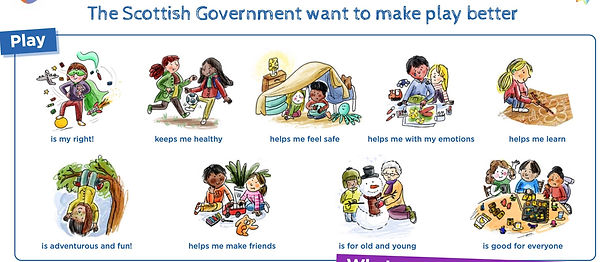
Play Scotland works closely with The Government of Scotland to support the importance of play. They have created a play vision action plan 2025-2030; an adult version and a one page children's version! The graphic below is part of the illustrated version. Scotland's Minister for Children, Young People and the Promise Natalie Don-Innes MSP, spoke at the International Play Association World Conference, Glasgow 2023. In the vision statement she reminds readers play is recognised as a child’s right in the United Nations Convention on the Rights of the Child but more than that, play can help to process emotions, build coping skills and help us navigate life events.
Loose Parts!
Play Scotland's site also promotes loose parts play. This type of play uses toys or objects that children may use it in many ways through imagination and creativity. This is much like the type of play Dr. Stuart Brown is advocating and Rich Louv, author of Last Child in the Woods states on the site, "...Nature, which excites all the senses, remains the richest source of loose parts.”
Please view Play Scotland loose part tool kit.
Mattel, a leading global toy and entertainment company supports the importance of play.
Purposeful Play
Citations for this page are located on the Resources tab
What about Risky Play?
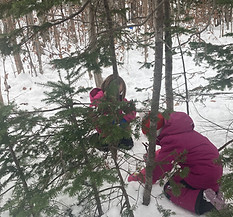
Risky Play defined by the Canadian Paediatric Society (CPS) is thrilling and exciting free play that involves uncertain outcomes and the possibility of physical injury. (Canadian Press, 2024) Risky play is usually done outside and thus would be beneficial for schools to include in an outdoor education regime. Risky play has recently come back to media attention due to the 2024 ban on 45 tobogganing hills across the city of Toronto. The ban cites trees and other hazards in the way of the slope. CPS quickly had a rebuttal for the ban. “CPS says risky play helps build physical and mental health and resilience among children and youth, and can help prevent or manage conditions like obesity, anxiety and behavioral issues.” (Kopun, 2024). All issues schools should be helping not stifling by being inside all day.
Dr. Mariana Brussoni, a veteran injury prevention researcher speaking on CBC Listen’s The Current explains anytime a physical activity is done such as in a sport, injury can occur. However, risky play builds into a child the ability to manage the strong emotions that come with uncertainty found in risky play. Orthopedic surgeons have told her they can fix a broken bone, so they would rather the children be outside playing. Her research shows similar benefits to risky play as Brown’s research with free play. She provided insight to how society got to this point where risky play is seen as too risky for children. Around the late 1980s after a series of recessions there was a move to intensive parenting. Parents wanted to make sure their child got the right experiences, got into the right university, and got the right job. As well the media was bombarding parents with images of kidnapped children on milk cartoons and stranger danger warnings so there was an unfounded perception the world was a dangerous place. This meant children had to have no free time and they had to be supervised and always safe.
She suggests ways to move society back to allowing risky play. First is to have information in the media and then have conversations with neighbors to encourage pockets of neighborhoods of like-minded adults allowing their children to engage in risky play; she believes this creates a community and will thus diminish feelings of being judged by other parents who might not understand the benefits to their children engaging in risky play. (The Current, 2024)
Megan Zeni's website offers more support for why children need risky play.
How does an individual educator, especially a seasoned one, be convinced to move her practice outside. Now it might not be realistic in a province with an unforgiving winter to expect educators to be outside each day for all hours. So how long do students need to be outside for any benefit to occur? Childhood by Nature studied the effects on spending time in nature in various time increments. They cite the Journal of Positive Psychology stating
just five minutes spent siting in nature allows one to experience an increase in positive emotions. Another study they cite allows for positive effects for students with ADHD with only a 20-minute commitment. “…in a study of the effects of nature walks on children with ADHD, kids each took three different walks: one in a green space, and two in quiet, urban settings with minimal levels of foot traffic. The researchers found that the kids showed enhanced concentration abilities after the 20-minute nature walk "roughly equal to the peak effects of two typical ADHD medications.” (Childhood by Nature, 2024).
In the United Kingdom the Wildlife Trusts took up one of the largest research studies to analyze the effects of regular outdoor activities on children’s wellbeing. The research argued “…every child in the UK to spend one hour outside in nature, every day, as part of the school curriculum.” (Joyner, 2019) Considering school lessons are from 30 -75 minutes it does seem possible that an educator can teach just one lesson outside each day, even for only five minutes. And hopefully this website might be a starting point for lessons and information for teachers to begin taking their teaching practice outside!