SAFETY FIRST: Outdoor Education is as safe as necessary. Please read the Canadian Paediatric Society's post here: Position Statement on Outdoor Risky Play


Read Aloud Lessons
I believe a leaf of grass is no less than the journey-work of the stars
- Wlalt Wiltman poet
Read Aloud
I enjoy reading a loud to my students. Whenever I can I have the students interact with the book: I say to the students a repeated common phrase in the book or have them act out parts of the book that lend themselves to movement, and of course, allow for connections, wonders, and ideas which enrich the story. I tend to read books with a nature theme, but any book read outside enriches students' mental, physical, social, and academic health. As well I tend to read picture books, but chapter books will also enrich students' learning. A grade four teacher is reading to her class The Wild Robot by Peter Brown. I think outside could greatly enhance the enjoyment of listening to this book!
And remember if you are still unsure about teaching outdoors you can simply read a short book or one chapter from a chapter book while outdoors with your students and then return to the classroom. Students and you will still benefit from the outdoors, even if it is for a short time. And a short reading time would be an effective step into this exciting pedagogy!
Below are some ideas and links to lessons/units which I include a read a loud. I placed more Read Aloud ideas on the Lessons with an Indigenous page of this site. I divided the Read Aloud into two sections so as not to overwhelm you. There are so many books you could use for a Read Aloud. Do you have a favorite? Please send me an email and we can share it on this site.
Back to Academics: Language Arts
Back to Resources
LAND PADDLING!
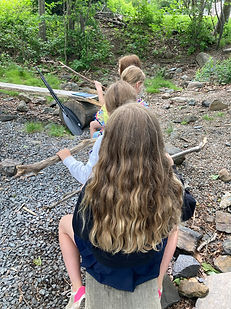
Land paddling I made up! The students are curious when I begin the lesson wearing my life jacket and carrying my paddle. What are we going to do?
I begin the lesson with a mini boat safety lesson. Wearing the correct size lifejacket, having a safety whistle on your lifejacket, and how to enter and exit the boat safely. I have each student find a stick to be their paddle!
Next I read the story In the Red Canoe by Leslie A. Davidson. The book is about a grandfather taking his grandson on a canoe journey. They pass a variety of wildlife and have quiet moments with nature, I stop reading throughout the book so students can paddle along with the duo. I also stop when particular wildlife is mentioned so we can take a moment to look closely at the picture and have a mini discussion about the wildlife. I have soft toys around our circle so we can pretend to paddle towards it when it is mentioned in the story. I have handed out puppets so students could act out the wildlife, but I found it took away from the discussion and the paddling so I wait until the end of the story to let them play with the puppets.
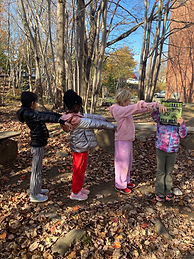
Monsters Can Mosey Understanding Shades of Meaning by Gillia M. Olson. This is a fun book and also relates to the primary outcomes of movement. As I read the story I have students act out the various monsters walks. At the end of the story we discuss the walks then I lead the discussion into how various wildlife walk. We act out how squirrels, foxes, and even bird walks! Although the book is for younger grades, it could be used as a opening for the grade 6 unit on Classification, Grade 4 Habitats, or Grade 3 Living Things.

Sneezy the Snowman by Maureen Wright
I learned this lesson in my mentorship program with the Outdoor Learning Store. You create a snowman out of felt. Glue that to a cookie sheet or another magnetic surface. On the reverse side you create a melted snowman. You create each piece from the book - mug, scarf, hot tub, fire, ice cream cone and seven scoops. As you read the story you place the particular piece (mug, scarf, etc) onto the magnetic board as if Sneezy is interacting with it. Oh no, most of these objects make him melt so you turn the magnetic surface around after each piece is placed. In the story Sneezy says, "Make me brand new" so you turn the board around to his original self. I have one student make the chickadee sound throughout the story, another student does the sneezing sound, and all students shout out Make Me Brand New! when Sneezy has melted.
Another teacher (thanks Mandy!) recommended after reading this book you could have students make a snowman. Note: this making of a snowman could occur immediately after the reading or another day depending on your amount of time your comfort level or allocated time allows you to be outside. If the snowman is built I think this could lead to having students write about the snowman in a creative story way or procedural writing of how they made the snowman.
No snow! No problem! Have students create a snowman out of nature objects such as rocks and sticks.
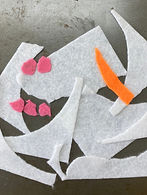
Make me brand new!